
Acufacial: Rediscover Your Natural Glow and Inner Balance
When we talk about facial rejuvenation, most people think of lasers, fillers or injectables. Traditional Chinese Medicine offers another option, one that works through acupuncture rather than devices or injections: Acufacial.
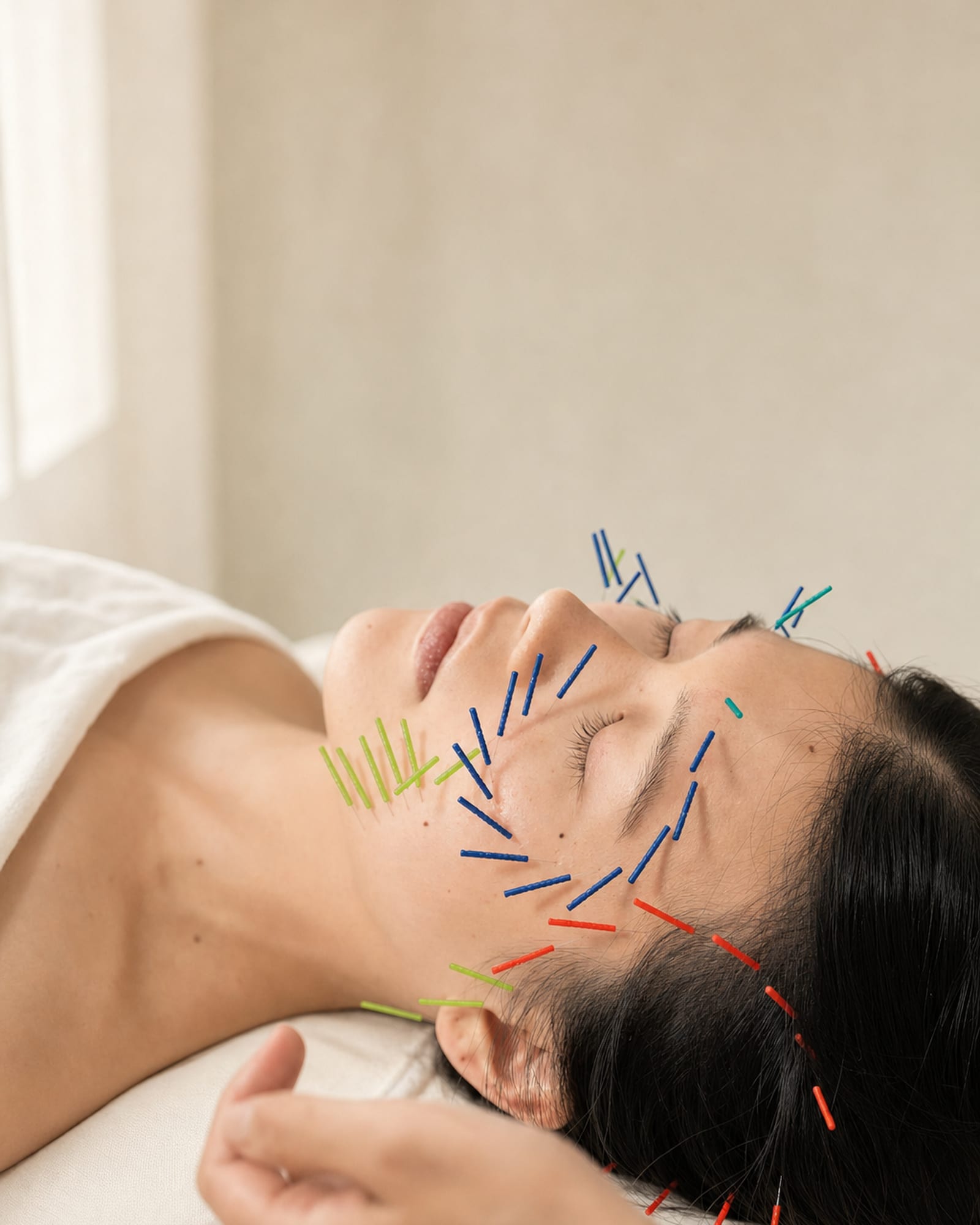
What Is Acufacial?
Acufacial is a modern adaptation of ancient Traditional Chinese Medicine (TCM). At its core, it’s a form of facial acupuncture, but with a twist: it focuses not only on beauty but on holistic health. By inserting ultra-fine Japanese Seirin needles—thinner than a human hair—into specific points on the face, the treatment activates deep layers of skin, fascia, and muscle.
It involves no injections or surgical tools; the needles alone do the work. The approach is rooted in centuries of TCM practice.
How Does It Work?
The secret lies in how the needles stimulate microcirculation, boost collagen production, and release tension in facial muscles. The result? Firmer, lifted skin and a natural glow from within.
But Acufacial doesn’t just work on the surface. According to TCM principles, the face reflects internal health. By targeting acupuncture points linked to organ systems, Acufacial can also improve sleep quality, balance hormones, and regulate emotions. You might come in for your skin—but you leave feeling more centered, less anxious, and even better rested.
What Conditions Can It Help?
People turn to Acufacial for a wide range of concerns, including:
- Sagging skin and facial laxity
- Fine lines and wrinkles
- Facial asymmetry
- Dull or uneven complexion
- Puffy eyes or facial swelling
- Enlarged pores and acne
Some even report improvements in jaw tension, sinus congestion, and overall skin sensitivity.
East Meets West: How Does It Compare to Modern Aesthetics?
Medical aesthetic treatments each target a specific concern: anti-wrinkle injections relax the muscles behind expression lines, lasers address pigmentation and texture, and fillers restore lost volume. They are performed by a doctor after an assessment of your skin, and the change is focused on the concern being treated.
Acufacial takes a different path. It works gradually across the whole face and, in TCM terms, alongside your overall well-being. Results build over a course of sessions rather than from a single visit.
The two are not either-or. Some people choose Acufacial on its own, others have it alongside medical treatments, and a consultation can help you decide which approach suits your skin.
Who Is It For?
Whether you're in your 20s looking to maintain youthful skin, or in your 40s and beyond trying to restore tone and vitality, Acufacial can be tailored to suit your needs. It's particularly loved by those who:
- Prefer natural treatments
- Have sensitive skin
- Value both inner and outer balance
- Prefer gradual, subtle changes
Final Thoughts
Acufacial offers a slow, steady approach to facial care, grounded in TCM. For those who prefer a gentle, needle-based treatment, or who want to complement other skin treatments, it is a path worth exploring.